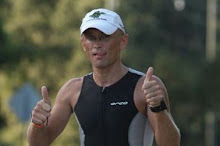
It has been about 3 weeks since we started doing the full half marathon loop with 5 x 5 minutes pushes for the final 30 minutes or so. Compared to our splits 3 weeks ago we were a lot faster today which is encouraging. Averages were:
1 - 3.56/km (6.20/mile)
2 - 3.46/km (6.03/mile)
3 - 3.40/km (5.55/mile)
4 - 3.45/km (6.02/mile)
5 - 3.42/km (5.58/mile)
By the end of next month I hope to be doing sub 6 minute mile pace comfortably for all five pushes.
Wednesday, February 18, 2009

Friday, February 13, 2009
Swim / Run at Public Beach
Last year we did some very successful swim / run training sessions at Seven Mile Beach (SMB) in preparation for the Ogier Stroke and Stride event.
At Public Beach (part of SMB) buoys can be used to define a swim course and cabanas as turn around points for the run. The last session we did before the final Stroke and Stride looked like this:
Today we (Marius, Johan and I) did a slightly different work out:
At Public Beach (part of SMB) buoys can be used to define a swim course and cabanas as turn around points for the run. The last session we did before the final Stroke and Stride looked like this:
- Swim 450m pushing hard to the first buoy
- Run hard to cabana and back
- Swim 450m with all out effort between first and second buoys
- Run hard to cabana and back
- 3 minutes rest
- Repeat set.
Today we (Marius, Johan and I) did a slightly different work out:
- Swim 1km along SMB
- Run 1km back to the starting point
- Swim 1km along SMB
- Run hard 1km to starting point.
Sunday, February 8, 2009
First long run of the year
Today, Russ and I did our first long (2.5 hr) run since we started training again after new years. We were joined by Johan for some of the way. Johan is training for IM South Africa in April.
After a slow and easy start to the morning, we had a good push the last 30 minutes or so finishing at a sustained pace of 4:15 - 4:00 min/km (see below, click on pic to enlarge). Total distance: 32.3 km.

After a slow and easy start to the morning, we had a good push the last 30 minutes or so finishing at a sustained pace of 4:15 - 4:00 min/km (see below, click on pic to enlarge). Total distance: 32.3 km.

Sunday, February 1, 2009
35th Annual Cross Island Relay
This morning I participated in the 35th annual Cross Island Relay.
The relay is the longest continually held running race in Cayman. It began its life as the "High School Cross Island Relay", conceived by PE teacher Winston Skinner, as an inter-house competition in 1975 (a similar race was run in his native Barbados). From the beginning other teams were welcome to participate. When the High School decided not to continue with the race the Hash House Harriers took over the tradition of organising the event.
The course runs from East to West. Starting in East End and finishing not far from George Town in the West. More specifically the 6 four mile legs are:
The Hash House Harriers have the course record of 2:14:04. The fastest female leg is held by Herfa Ebanks in a time of 24:12 set in 1984 (barefoot apparently!). That year Tim Byrne also set the record of the fastest individual leg in a time of 20:12.
I ran with the team "Beauty and the Beasts". They came second last year to UBS1 so were keen on revenge. The line-up for our 6 legs were as follows:
Start was 6 am in East End which meant an early 4:45 am wake-up to get there on time. Once at the start-line it became clear I would be "battling" Sammy from UBS. He has a reputation as a fast starter and sure enough the first km was run in 3:34. Next km was also a fast 3:39, but I was gradually able to pull away. I kept a good pace for the third km, but started to feel the quick start about half way and at times I dropped the pace to a more human 4 min/km. However, I managed a decent sprint finish. My average pace for the whole run was 3:45 min/km (6:02 min/mile) which translates to a finish time of 24:09. However, my official time for the race was 24:45. My Garmin is usually not that far off, so I guess the leg is long, maybe not the full 160m according to the Garmin, but at least 100m. I will check it on the bike one of these days for good measure. Regardless, I am happy with the outcome and think I am making good progress in my running at this stage.
While the outcome of the relay last year was determined on the last leg there was not much excitement this year with us leading from start to finish. All team members ran some great times. Our final time was 2:24:50, which translates to a 24:08 average per leg.
Picture of the winning team below (from left to right; Jasper, Marius, JP, Russel, Beth, Hayden).

UPDATE: Measured the leg on the bike this weekend, was approx. 145m too long.
The relay is the longest continually held running race in Cayman. It began its life as the "High School Cross Island Relay", conceived by PE teacher Winston Skinner, as an inter-house competition in 1975 (a similar race was run in his native Barbados). From the beginning other teams were welcome to participate. When the High School decided not to continue with the race the Hash House Harriers took over the tradition of organising the event.
The course runs from East to West. Starting in East End and finishing not far from George Town in the West. More specifically the 6 four mile legs are:
- 1-Gun Bay -> Blow Holes
- 2-Blow Holes -> Frank Sound Junction
- 3-Frank Sound -> Junction Old Drive-In by Everglow
- 4-Old Drive-In by Everglow ->Savannah Meadows
- 5-Savannah Meadows -> Sunrise Apartments South Sound
- 6-Sunrise Apartments South Sound -> Smith Cove
The Hash House Harriers have the course record of 2:14:04. The fastest female leg is held by Herfa Ebanks in a time of 24:12 set in 1984 (barefoot apparently!). That year Tim Byrne also set the record of the fastest individual leg in a time of 20:12.
I ran with the team "Beauty and the Beasts". They came second last year to UBS1 so were keen on revenge. The line-up for our 6 legs were as follows:
- 1 -Jasper
- 2 -Beth
- 3 -Marius
- 4 -Hayden
- 5 -JP
- 6 -Russ
Start was 6 am in East End which meant an early 4:45 am wake-up to get there on time. Once at the start-line it became clear I would be "battling" Sammy from UBS. He has a reputation as a fast starter and sure enough the first km was run in 3:34. Next km was also a fast 3:39, but I was gradually able to pull away. I kept a good pace for the third km, but started to feel the quick start about half way and at times I dropped the pace to a more human 4 min/km. However, I managed a decent sprint finish. My average pace for the whole run was 3:45 min/km (6:02 min/mile) which translates to a finish time of 24:09. However, my official time for the race was 24:45. My Garmin is usually not that far off, so I guess the leg is long, maybe not the full 160m according to the Garmin, but at least 100m. I will check it on the bike one of these days for good measure. Regardless, I am happy with the outcome and think I am making good progress in my running at this stage.
While the outcome of the relay last year was determined on the last leg there was not much excitement this year with us leading from start to finish. All team members ran some great times. Our final time was 2:24:50, which translates to a 24:08 average per leg.
Picture of the winning team below (from left to right; Jasper, Marius, JP, Russel, Beth, Hayden).

UPDATE: Measured the leg on the bike this weekend, was approx. 145m too long.
Friday, January 30, 2009
Group riding
Although we don't ride in packs or groups in non-drafting triathlon events, it is good to know the rules of group riding. Pez cycling has a good overview today of the basic rules to follow. You can access the article here.
Key take-aways include:
Key take-aways include:
- Whenever riding in a group you should be riding 2 by 2, side by side, handlebar to handlebar keeping it tight.
- When there is an uneven number of riders you should place yourself in between the two riders ahead of you, with your front wheel between their two rear wheels.
- When peeling off gradually move to the outside and let the group come through the middle.
- There should be no gaps in a group ride.
- Move gradually and steadily.
- Use hand signals to indicate obstacles.
- When someone slows down ahead of you, don't jump for the brakes. You should be riding ever so slightly to the side of the rider in front of you; so when they slow down, you either stop pedaling and start to slightly overlap your front wheel with their rear wheel, or you touch the brakes gradually, once again using the “wheel overlap” as a buffer zone so as not to slow down too suddenly for the riders behind you.
Thursday, January 29, 2009
Events Schedule Cayman
Today I received the events schedule from the new President of the Cayman Triathlon Association. It is as follows:
The local events I will be doing this year include: the Cross Island Relay, the Duathlon, all the sea swims I can fit in, at least one or two of the Stroke and Stride events (swim followed by run), the Cayman TT championships, the Turtle Tri, the Pirates Week 10k and finally the half marathon. I might convert the half to a full, only time will tell.
- Jan 31 Kiwanis Bikeathon
- Feb 1 Cross Island Relay(6 x 4 miles)
- March 17 Irish Jog (5 km)
- March 29 DHL Duathlon
- June 20 Flowers Sea Swim (1 mile)
- June 28 Social Triathlon
- Aug 12, 19, 26 Stroke and Stride Series
- Sept Fidelity Series Runs (3 x 2 miles)
- Oct 18, Nov 1, Nov 15 Triathlon Build Up Series
- Nov 29 Turtle tri (Olympic distance)
- Dec 4 Cayman Islands Marathon
- Dec 25 Christmas Day Triathlon
- Dec 26 “Dashing Thru the Sand” Beach
The local events I will be doing this year include: the Cross Island Relay, the Duathlon, all the sea swims I can fit in, at least one or two of the Stroke and Stride events (swim followed by run), the Cayman TT championships, the Turtle Tri, the Pirates Week 10k and finally the half marathon. I might convert the half to a full, only time will tell.
Wednesday, January 28, 2009
Dreaded Wednesday
Today was the first time in a while Russ, Scott and I did the full half marathon loop. We have been building up to this mid-week medium-long run since the beginning of January. Today we did the first hour at around 4:30 min/km pace and the last 35 minutes with 5 minute pushes with 2 minutes active recovery. The pushes were run around 4 min/km pace which is slightly slower than we did them last year. Suffice to say, five pushes at that pace was more than sufficient for me. In coming weeks the pushes will get tougher as we approach Scott's marathon race pace of around 3:45 min/km and beyond (well, not for me).
Seems to me this is an excellent workout. It is long enough to stimulate endurance, yet short enough to not prolong recovery. In addition, it allows us to incorporate a variety of intensities that would be difficult in longer runs and in particular to recruit muscle fibers at tempo speeds when they have already been taxed for an hour or so.
UPDATE: Scott provided the push splits:
1- 4.14/km ave
2- 4.06/km ave
3- 3.59/km ave
4- 3.55/km ave
5- 3.52/km ave
No wonder I was feeling the heat on the last one.
Seems to me this is an excellent workout. It is long enough to stimulate endurance, yet short enough to not prolong recovery. In addition, it allows us to incorporate a variety of intensities that would be difficult in longer runs and in particular to recruit muscle fibers at tempo speeds when they have already been taxed for an hour or so.
UPDATE: Scott provided the push splits:
1- 4.14/km ave
2- 4.06/km ave
3- 3.59/km ave
4- 3.55/km ave
5- 3.52/km ave
No wonder I was feeling the heat on the last one.
Friday, January 23, 2009
Getting Sloshed
A slosh pipe or tube is a large PVC pipe filled partially with water and capped on the ends. I understand that working out with one of these is very effective and surprisingly difficult.
All that is needed is a PVC pipe from the local hardware store 2-3 meters long and 5-10 cm in diameter. The longer and wider the pipe the more difficult it is to use. A cap for both ends and water to it at least 1/2 full of water.
The sloshing part comes from the water moving around inside the pipe when you pick it up and hold it horizontally. This is what makes it so difficult to use. The slightest imbalance moves the water inside. Fighting both the weight of the tube and momentum, makes movement of the tube very taxing on the core.
Check out this guy, here is "only" trying to hold it stationary:
I am off to AL Thompson this weekend.
All that is needed is a PVC pipe from the local hardware store 2-3 meters long and 5-10 cm in diameter. The longer and wider the pipe the more difficult it is to use. A cap for both ends and water to it at least 1/2 full of water.
The sloshing part comes from the water moving around inside the pipe when you pick it up and hold it horizontally. This is what makes it so difficult to use. The slightest imbalance moves the water inside. Fighting both the weight of the tube and momentum, makes movement of the tube very taxing on the core.
Check out this guy, here is "only" trying to hold it stationary:
I am off to AL Thompson this weekend.
Subscribe to:
Comments (Atom)